DP-420 Valid Dumps Sheet & New DP-420 Test Papers
Wiki Article
P.S. Free & New DP-420 dumps are available on Google Drive shared by Exam4Tests: https://drive.google.com/open?id=1ZXxwdZx95GmJMuBzCK-bSnJnY0_hBnV6
We can say that the Microsoft DP-420 practice questions are the top-notch Designing and Implementing Cloud-Native Applications Using Microsoft Azure Cosmos DB (DP-420) dumps that will provide you with everything that you must need for instant DP-420 exam preparation. Take the right decision regarding your quick Designing and Implementing Cloud-Native Applications Using Microsoft Azure Cosmos DB (DP-420) exam questions preparation and download the real, valid, and updated Microsoft DP-420 exam dumps and start this journey.
Microsoft DP-420 exam is designed for professionals who want to learn how to design and implement cloud-native applications using Microsoft Azure Cosmos DB. DP-420 exam is ideal for developers, architects, and IT professionals who have experience in building and deploying applications on Azure and want to deepen their knowledge of cloud-native application development. Passing the DP-420 Exam demonstrates that you have the skills and knowledge needed to design and implement cloud-native applications using Azure Cosmos DB.
>> DP-420 Valid Dumps Sheet <<
DP-420 Valid Dumps Sheet|Easy to Pass The Designing and Implementing Cloud-Native Applications Using Microsoft Azure Cosmos DB
Remember that this is a crucial part of your career, and you must keep pace with the changing time to achieve something substantial in terms of a certification or a degree. So do avail yourself of this chance to get help from our exceptional Designing and Implementing Cloud-Native Applications Using Microsoft Azure Cosmos DB (DP-420) dumps to grab the most competitive Microsoft DP-420 certificate. Exam4Tests has formulated the Designing and Implementing Cloud-Native Applications Using Microsoft Azure Cosmos DB (DP-420) product in three versions. You will find their specifications below to understand them better.
Microsoft Designing and Implementing Cloud-Native Applications Using Microsoft Azure Cosmos DB Sample Questions (Q235-Q240):
NEW QUESTION # 235
You have an Apache Spark pool in Azure Synapse Analytics that runs the following Python code in a notebook.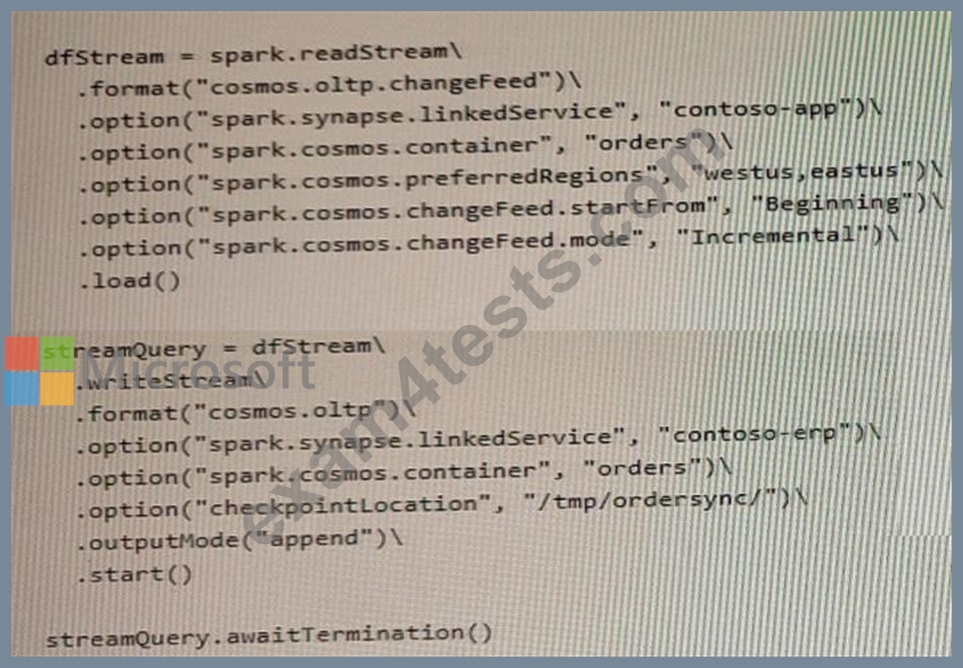
For each of the following statements, select Yes if the statement is true. Otherwise, select No.
NOTE: Each correct selection is worth one point.
Answer:
Explanation:
Explanation:
New and updated orders will be added to contoso-erp.orders: Yes
The code performs bulk data ingestion from contoso-app: No
Both contoso-app and contoso-erp have Analytics store enabled: Yes
The code uses the spark.readStream method to read data from a container named orders in a database named contoso-app. The data is then filtered by a condition and written to another container named orders in a database named contoso-erp using the spark.writeStream method. The write mode is set to "append", which means that new and updated orders will be added to the destination container1.
The code does not perform bulk data ingestion from contoso-app, but rather stream processing. Bulk data ingestion is a process of loading large amounts of data into a data store in batches. Stream processing is a process of continuously processing data as it arrives in real-time2.
Both contoso-app and contoso-erp have Analytics store enabled, because they are both accessed by Spark pools using the spark.cosmos.oltp method. This method requires that the containers have Analytics store enabled, which is a feature that allows Spark pools to query data stored in Azure Cosmos DB containers using SQL APIs3.
NEW QUESTION # 236
You need to implement a solution to meet the product catalog requirements.
What should you do to implement the conflict resolution policy.
- A. Disable indexing on all fields in the index policy of the con-product container.
- B. Set the default consistency level for account1 to eventual.
- C. Remove frequently changed field from the index policy of the con-product container.
- D. Create a new container and migrate the product catalog data to the new container.
Answer: B
Explanation:
Topic 1, Litware, inc
Case Study
This is a case study. Case studies are not timed separately. You can use as much exam time as you would like to complete each case. However, there may be additional case studies and sections on this exam. You must manage your time to ensure that you are able to complete all questions included on this exam in the time provided.
To answer the questions included in a case study, you will need to reference information that is provided in the case study. Case studies might contain exhibits and other resources that provide more information about the scenario that is described in the case study. Each question is independent of the other questions in this case study.
At the end of this case study, a review screen will appear. This screen allows you to review your answers and to make changes before you move to the next section of the exam. After you begin a new section, you cannot return to this section.
To start the case study
To display the first question in this case study, click the Next button. Use the buttons in the left pane to explore the content of the case study before you answer the questions. Clicking these buttons displays information such as business requirements, existing environment, and problem statements. If the case study has an All Information tab, note that the information displayed is identical to the information displayed on the subsequent tabs. When you are ready to answer a question, click the Question button to return to the question.
Overview
Litware, Inc. is a United States-based grocery retailer. Litware has a main office and a primary datacenter in Seattle. The company has 50 retail stores across the United States and an emerging online presence. Each store connects directly to the internet.
Existing environment. Cloud and Data Service Environments.
Litware has an Azure subscription that contains the resources shown in the following table.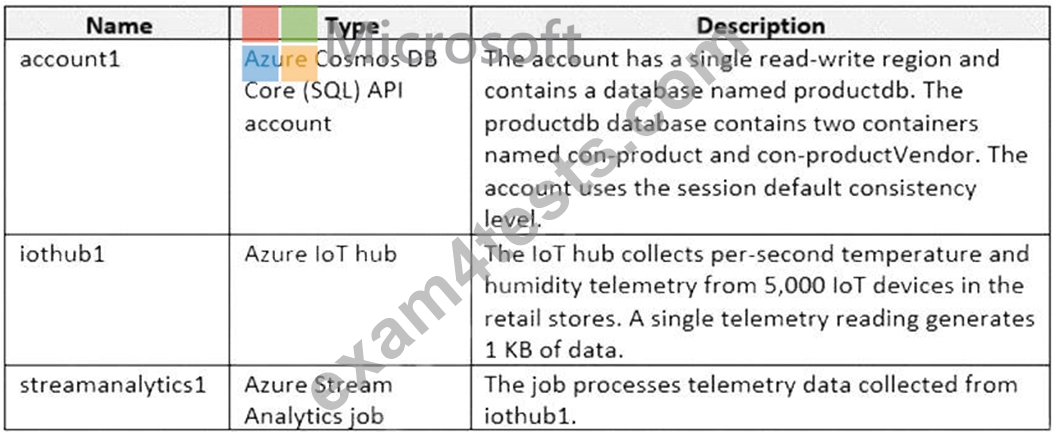
Each container in productdb is configured for manual throughput.
The con-product container stores the company ' s product catalog data. Each document in con-product includes a con-productvendor value. Most queries targeting the data in con-product are in the following format.
SELECT * FROM con-product p WHERE p.con-productVendor - ' name '
Most queries targeting the data in the con-productVendor container are in the following format SELECT * FROM con-productVendor pv ORDER BY pv.creditRating, pv.yearFounded Existing environment. Current Problems.
Litware identifies the following issues:
Updates to product categories in the con-productVendor container do not propagate automatically to documents in the con-product container.
Application updates in con-product frequently cause HTTP status code 429 " Too many requests " . You discover that the 429 status code relates to excessive request unit (RU) consumption during the updates.
Requirements. Planned Changes
Litware plans to implement a new Azure Cosmos DB Core (SQL) API account named account2 that will contain a database named iotdb. The iotdb database will contain two containers named con-iot1 and con-iot2.
Litware plans to make the following changes:
Store the telemetry data in account2.
Configure account1 to support multiple read-write regions.
Implement referential integrity for the con-product container.
Use Azure Functions to send notifications about product updates to different recipients.
Develop an app named App1 that will run from all locations and query the data in account1.
Develop an app named App2 that will run from the retail stores and query the data in account2. App2 must be limited to a single DNS endpoint when accessing account2.
Requirements. Business Requirements
Litware identifies the following business requirements:
Whenever there are multiple solutions for a requirement, select the solution that provides the best performance, as long as there are no additional costs associated.
Ensure that Azure Cosmos DB costs for IoT-related processing are predictable.
Minimize the number of firewall changes in the retail stores.
Requirements. Product Catalog Requirements
Litware identifies the following requirements for the product catalog:
Implement a custom conflict resolution policy for the product catalog data.
Minimize the frequency of errors during updates of the con-product container.
Once multi-region writes are configured, maximize the performance of App1 queries against the data in account1.
Trigger the execution of two Azure functions following every update to any document in the con-product container.
NEW QUESTION # 237
You need to create a database in an Azure Cosmos DB for NoSQL account. The database will contain three containers named coll1, coll2 and coll3. The coll1 container will have unpredictable read and write volumes. The col!2 and coll3 containers will have predictable read and write volumes. The expected maximum throughput for coll1 and coll2 is 50,000 request units per second (RU/s) each.
How should you provision the collection while minimizing costs?
- A. Create a provisioned throughput account. Set the throughput for coll1 to Manual. Set the throughput for coll2 and coll3 to Autoscale.
- B. Create a provisioned throughput account. Set the throughput for call1 to Autoscale. Set the throughput for call2 and coll3 to Manual.
- C. Create a serverless account.
Answer: B
Explanation:
Azure Cosmos DB offers two different capacity modes: provisioned throughput and serverless1. Provisioned throughput mode allows you to configure a certain amount of throughput (expressed in Request Units per second or RU/s) that is provisioned on your databases and containers. You get billed for the amount of throughput you've provisioned, regardless of how many RUs were consumed1. Serverless mode allows you to run your database operations without having to configure any previously provisioned capacity. You get billed for the number of RUs that were consumed by your database operations and the storage consumed by your data1.
To create a database that minimizes costs, you should consider the following factors:
The read and write volumes of your containers
The predictability and variability of your traffic
The latency and throughput requirements of your application
The geo-distribution and availability needs of your data
Based on these factors, one possible option that you could choose is B. Create a provisioned throughput account. Set the throughput for coll1 to Autoscale. Set the throughput for coll2 and coll3 to Manual.
This option has the following advantages:
It allows you to handle unpredictable read and write volumes for coll1 by using Autoscale, which automatically adjusts the provisioned throughput based on the current load1.
It allows you to handle predictable read and write volumes for coll2 and coll3 by using Manual, which lets you specify a fixed amount of provisioned throughput that meets your performance needs1.
It allows you to optimize your costs by paying only for the throughput you need for each container1.
It allows you to enable geo-distribution for your account if you need to replicate your data across multiple regions1.
This option also has some limitations, such as:
It may not be suitable for scenarios where all containers have intermittent or bursty traffic that is hard to forecast or has a low average-to-peak ratio1.
It may not be optimal for scenarios where all containers have low or sporadic traffic that does not justify provisioned capacity1.
It may not support availability zones or multi-master replication for your account1.
Depending on your specific use case and requirements, you may need to choose a different option. For example, you could use a serverless account if all containers have low or sporadic traffic that does not require predictable performance or geo-distribution1. Alternatively, you could use a provisioned throughput account with Manual for all containers if all containers have stable and consistent traffic that requires predictable performance or geo-distribution1.
NEW QUESTION # 238
You have an Azure Cosmos DB container named container! that has a provisioned throughput and two physical partitions. You monitor the following metrics for container1
* Normalized RU consumption
* The percentage of requests that have an HTTP status code of 429
You need to confirm that container1 is configured to maximize resource utilization.
What are the optimal values for each metric? To answer, select the appropriate options in the answer area.
NOTE: Each correct selection is worth one point.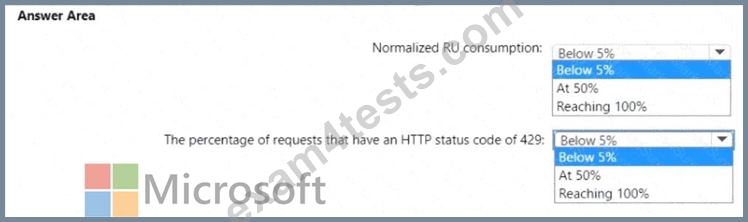
Answer:
Explanation: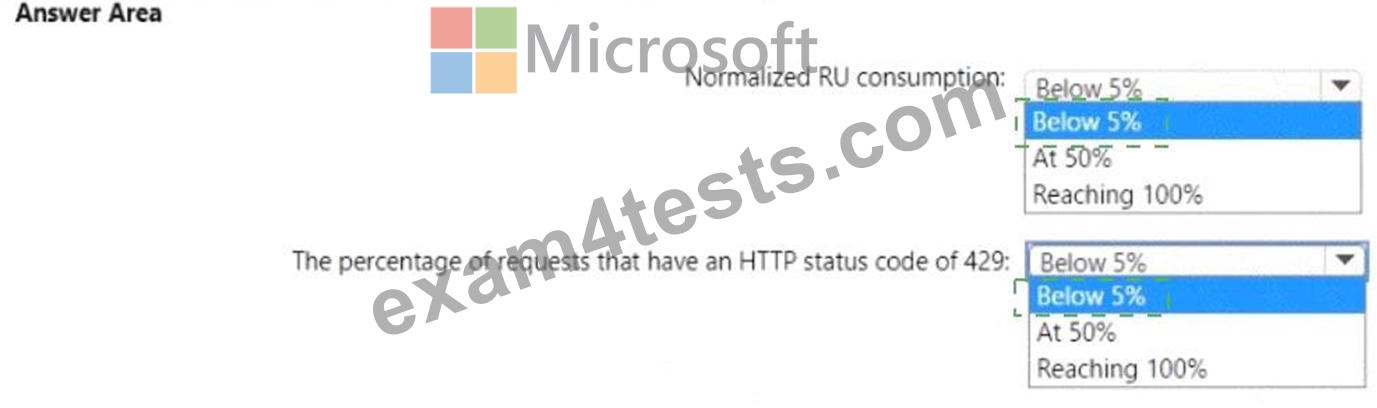
Explanation:
NEW QUESTION # 239
You have an Azure subscription that contains an Azure Cosmos DB for NoSQL account. The account hosts a container named Container1.
At some point during the past 4S hours, Container1 was deleted.
You need to restore the account to immediately before the deletion of Container1. The solution must minimize administrative effort.
What should you do first?
- A. Restore Container1 to a different Azure Cosmos DB for NoSQL account.
- B. Create a new Azure Cosmos DB for NoSQL account.
- C. Review the event feed blade.
- D. Identify the last restorable timestamp.
Answer: D
Explanation:
Azure Cosmos DB provides a point-in-time restore (PITR) feature, which allows you to restore data to a previous state. To restore a deleted container like Container1, the first step is to identify the last restorable timestamp. This timestamp would be the point in time immediately before the deletion of the container.
Once you have identified the correct timestamp, you can proceed with the restore process.
Cosmos DB allows you to restore the container to either the same or a different account, but identifying the timestamp is the crucial first step.
NEW QUESTION # 240
......
Our Desktop version is an application software that runs without an internet connection. It helps you to test yourself by giving the Designing and Implementing Cloud-Native Applications Using Microsoft Azure Cosmos DB (DP-420) practice test. Our desktop version also keeps a record of your previous performance and it shows the improvement in your next DP-420 Practice Exam. With the help of Exam4Tests Designing and Implementing Cloud-Native Applications Using Microsoft Azure Cosmos DB (DP-420) exam questions, you will be able to pass the Microsoft DP-420 certification exam with ease. When you invest in our product it will surely benefit your Designing and Implementing Cloud-Native Applications Using Microsoft Azure Cosmos DB (DP-420) exam dumps.
New DP-420 Test Papers: https://www.exam4tests.com/DP-420-valid-braindumps.html
- DP-420 Free Practice ???? Reliable DP-420 Study Materials ???? Reliable DP-420 Exam Tips ???? Easily obtain free download of ➥ DP-420 ???? by searching on ▶ www.pdfdumps.com ◀ ????DP-420 Valid Dumps Demo
- Test DP-420 Dates ???? DP-420 Test Questions ???? DP-420 Free Practice ???? Open ▷ www.pdfvce.com ◁ and search for ( DP-420 ) to download exam materials for free ????DP-420 Pass4sure Dumps Pdf
- Valid DP-420 Exam Materials ???? DP-420 Reliable Cram Materials ???? Valid DP-420 Exam Materials ???? Search for ⮆ DP-420 ⮄ and obtain a free download on ▛ www.troytecdumps.com ▟ ????Valid DP-420 Exam Materials
- 100% Pass 2026 Latest Microsoft DP-420: Designing and Implementing Cloud-Native Applications Using Microsoft Azure Cosmos DB Valid Dumps Sheet ???? Search for ☀ DP-420 ️☀️ on ▛ www.pdfvce.com ▟ immediately to obtain a free download ????Reliable DP-420 Study Materials
- DP-420 Valid Dumps Demo ???? DP-420 Latest Braindumps Pdf ???? New DP-420 Test Experience ⏸ Open ☀ www.testkingpass.com ️☀️ and search for ➠ DP-420 ???? to download exam materials for free ????DP-420 Free Practice
- DP-420 Reliable Exam Blueprint ???? DP-420 Pass4sure Dumps Pdf ???? Latest DP-420 Cram Materials ⚛ Open ⮆ www.pdfvce.com ⮄ enter ( DP-420 ) and obtain a free download ????DP-420 Latest Exam Tips
- DP-420 Valid Dumps Demo ???? DP-420 Latest Exam Tips ???? Reliable DP-420 Study Materials ???? Open ☀ www.practicevce.com ️☀️ and search for 《 DP-420 》 to download exam materials for free ➰Exam DP-420 Guide Materials
- Authoritative DP-420 Valid Dumps Sheet - Leading Offer in Qualification Exams - Trusted Microsoft Designing and Implementing Cloud-Native Applications Using Microsoft Azure Cosmos DB ✋ { www.pdfvce.com } is best website to obtain ⮆ DP-420 ⮄ for free download ????Test DP-420 Dates
- Top DP-420 Dumps ???? DP-420 Valid Dumps Demo ???? DP-420 Pass4sure Dumps Pdf ???? Search for 《 DP-420 》 and download it for free on ▛ www.prepawayexam.com ▟ website ????DP-420 Reliable Cram Materials
- Valid DP-420 Exam Materials ???? DP-420 Pass4sure Dumps Pdf ???? DP-420 Reliable Cram Materials ???? Immediately open ➡ www.pdfvce.com ️⬅️ and search for ➤ DP-420 ⮘ to obtain a free download ????DP-420 Valid Test Practice
- DP-420 Valid Dumps Demo ???? Reliable DP-420 Exam Tips ???? DP-420 Reliable Cram Materials ⤴ Open { www.prepawaypdf.com } and search for 《 DP-420 》 to download exam materials for free ????DP-420 Valid Test Practice
- finnianjgck618243.therainblog.com, royoola373137.snack-blog.com, www.stes.tyc.edu.tw, tinybookmarks.com, linkdirectory724.com, kbookmarking.com, lancecrfy606015.wikitron.com, gretawtdq084455.blogcudinti.com, louisedozh194134.hazeronwiki.com, imogenjsfu454482.elbloglibre.com, Disposable vapes
2026 Latest Exam4Tests DP-420 PDF Dumps and DP-420 Exam Engine Free Share: https://drive.google.com/open?id=1ZXxwdZx95GmJMuBzCK-bSnJnY0_hBnV6
Report this wiki page